LGPS SAA Peer Portfolios
We analysed how LGPS funds changed their asset mix between March 2022 and March 2025



Crafting Clarity in a
World of Complexity

Learn more about
Camdor Global Advisors

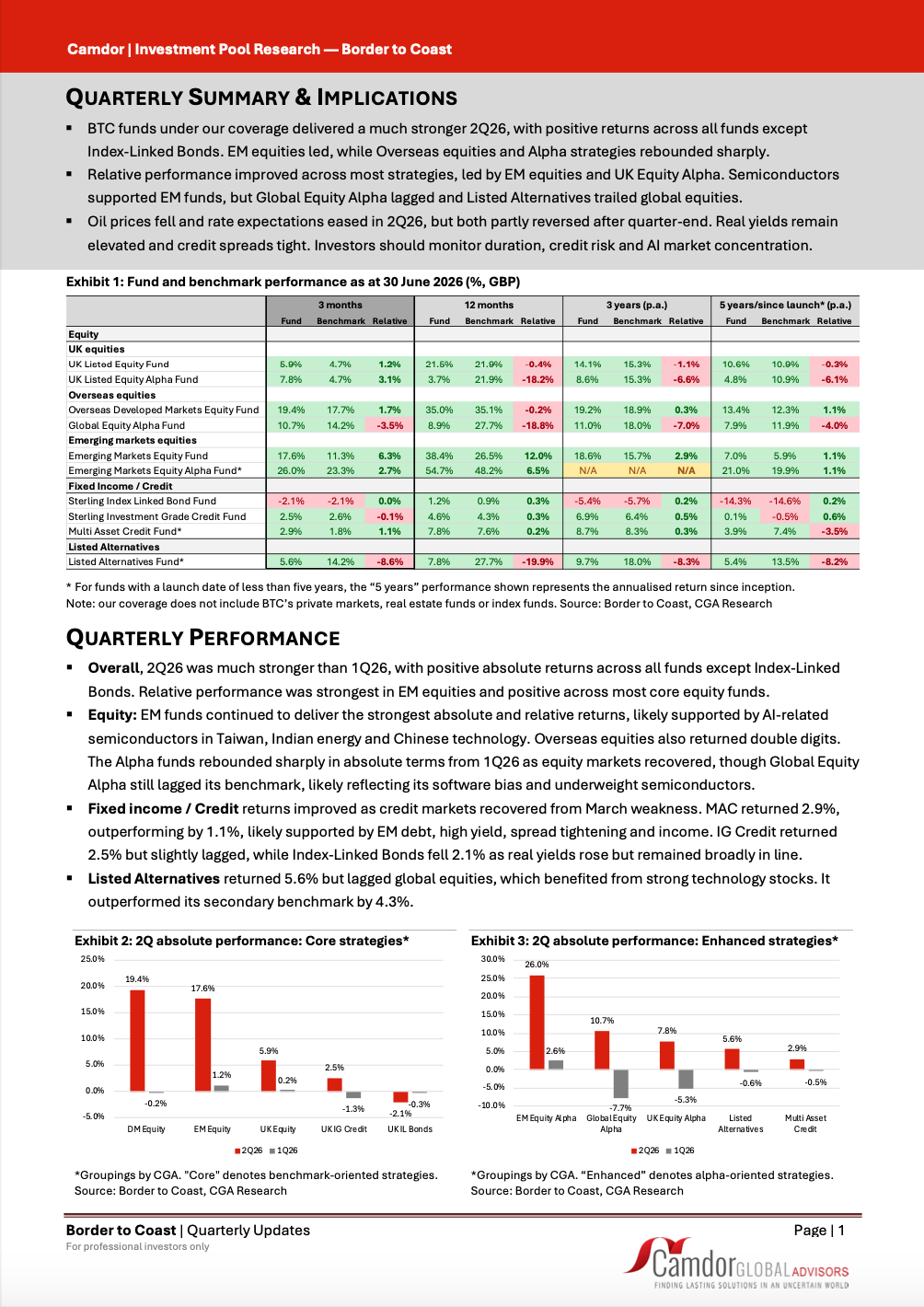
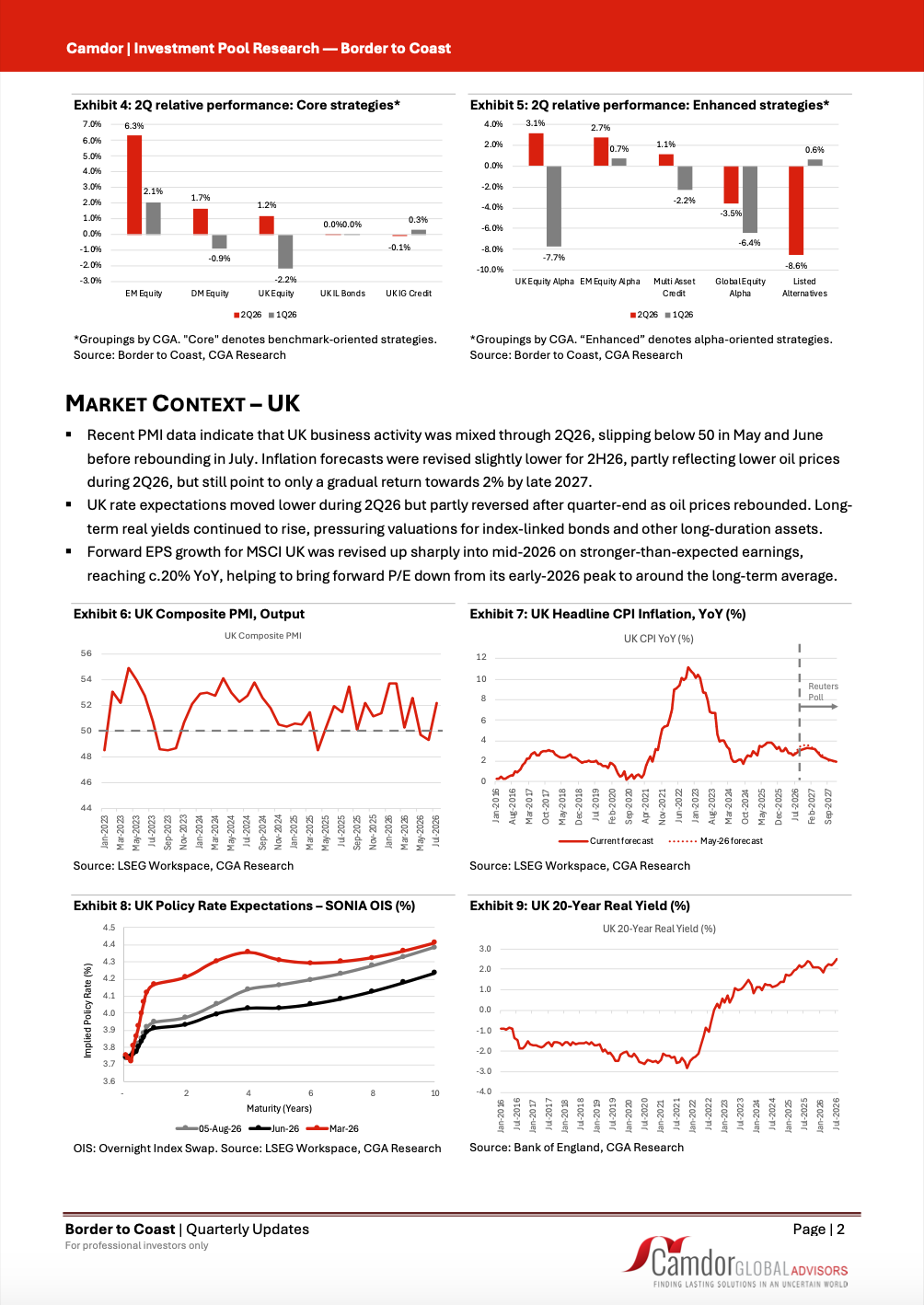
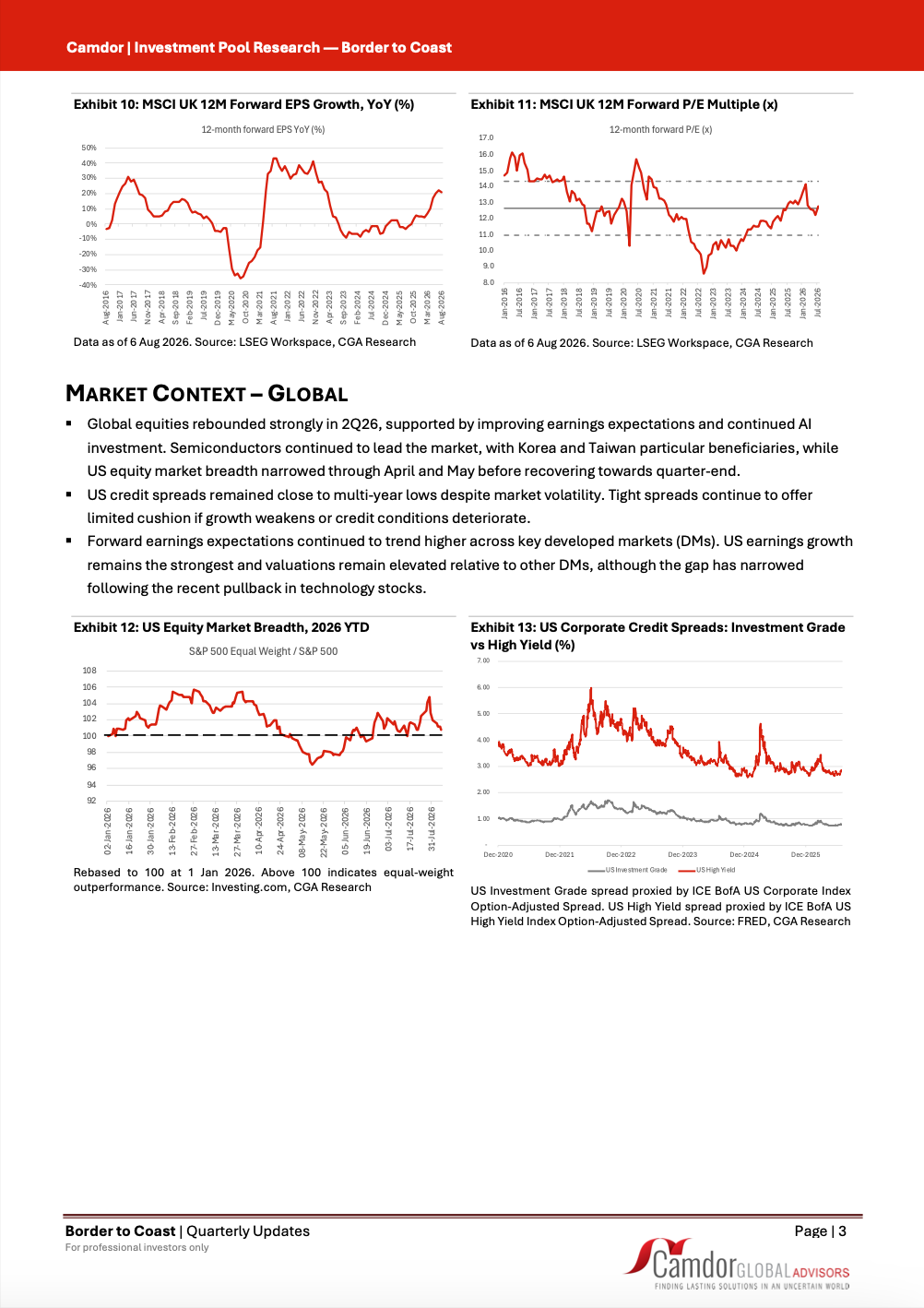
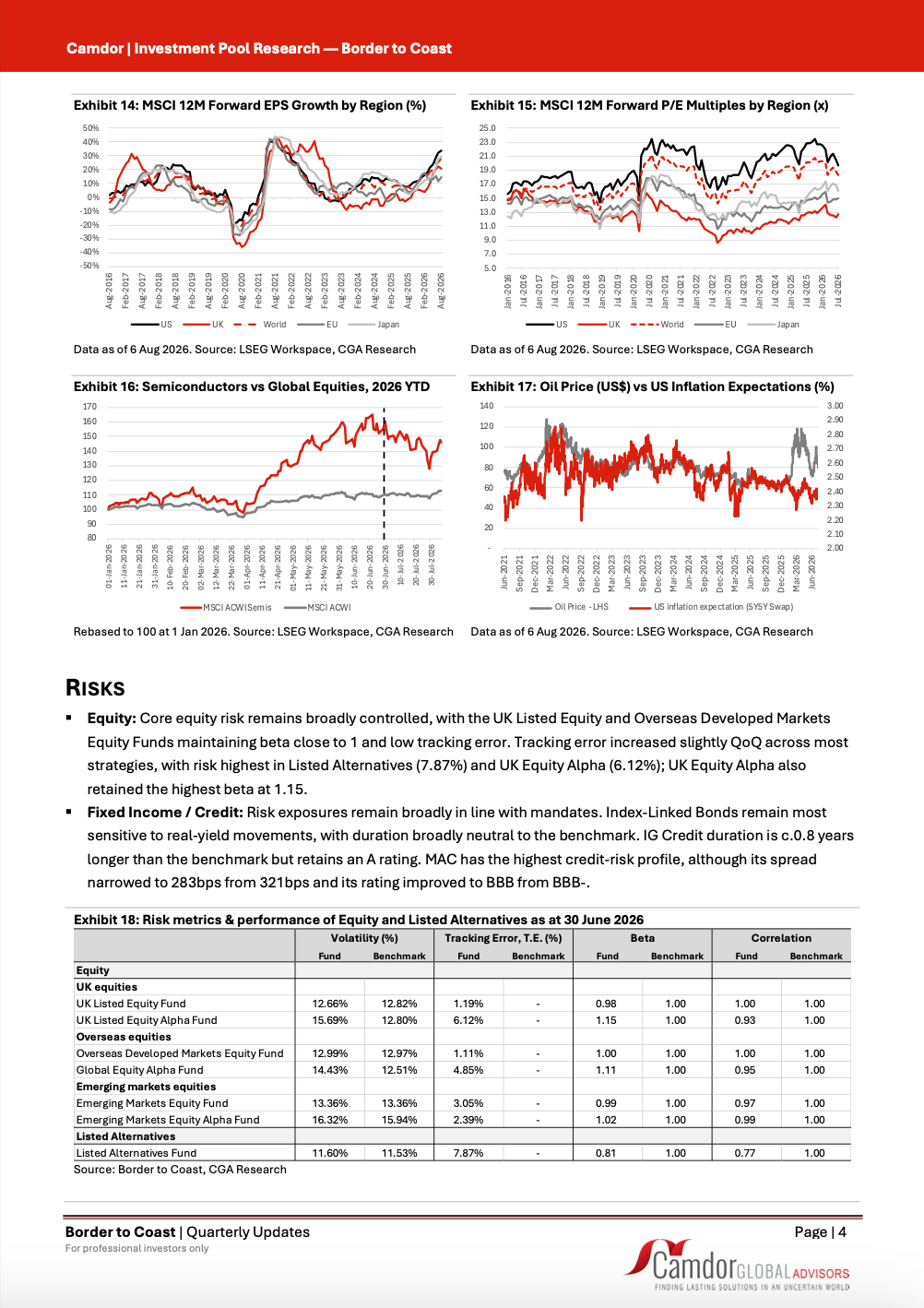
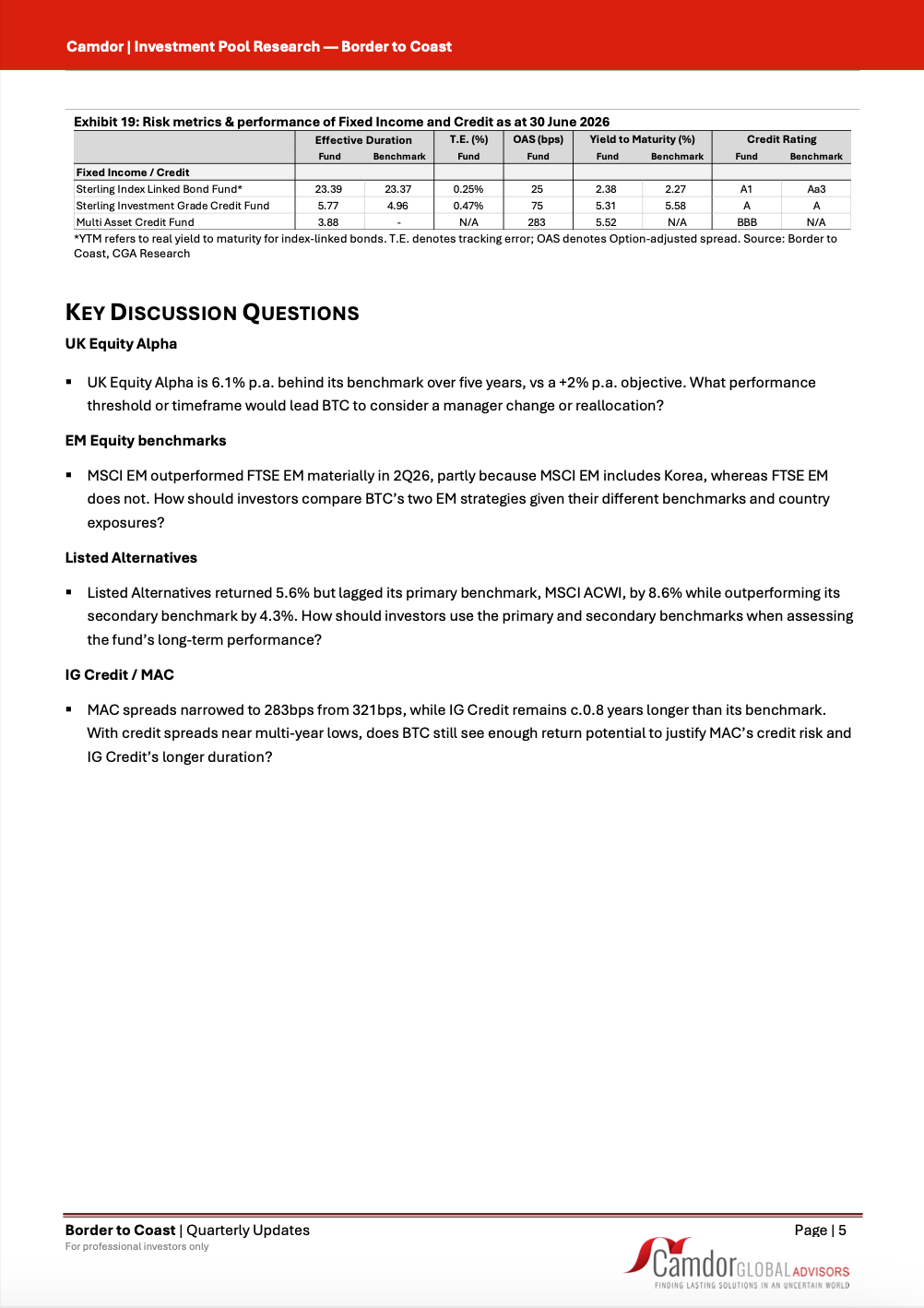
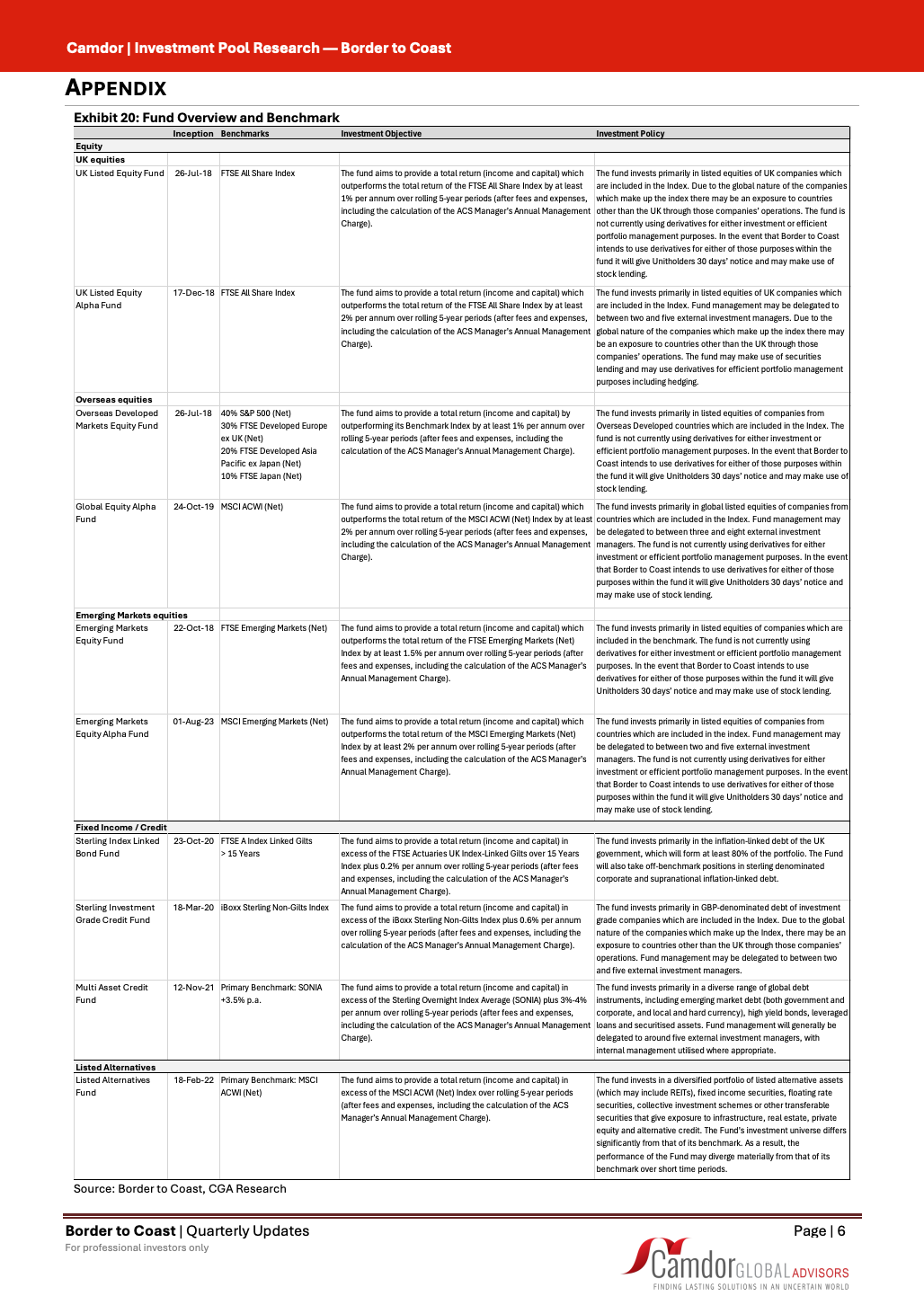
Our latest Border to Coast (BTC) quarterly review is now available, covering 2Q26 fund performance, market context, key risks and discussion points for LGPS investors.
2Q26 saw a marked improvement across most strategies, with Emerging Markets leading performance, while elevated real yields, tight credit spreads and AI market concentration remain key areas to monitor
For professional investors only.
Contact Camdor Global Advisors:
Emerson Chan
emerson@camdorglobaladvisors.com

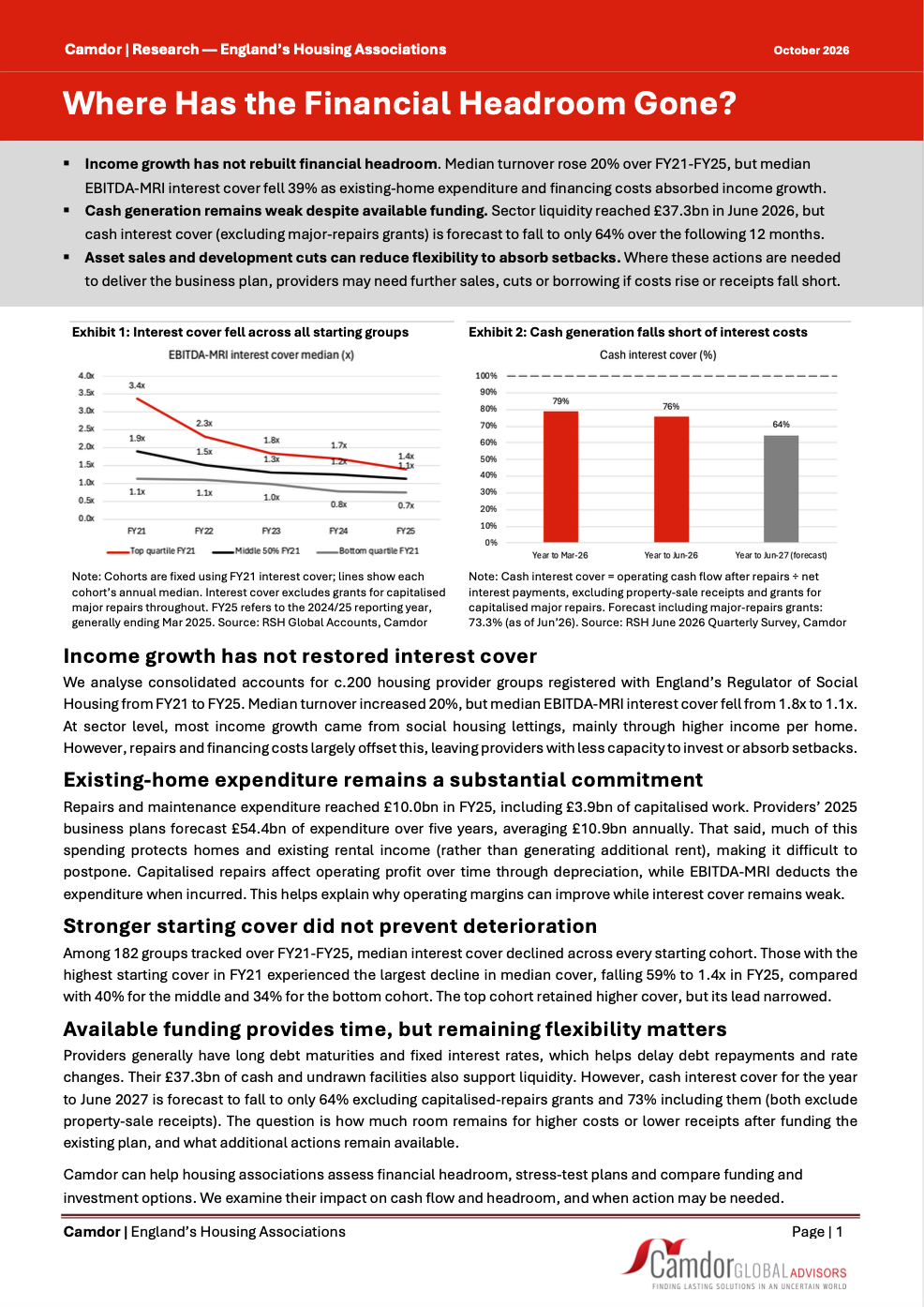
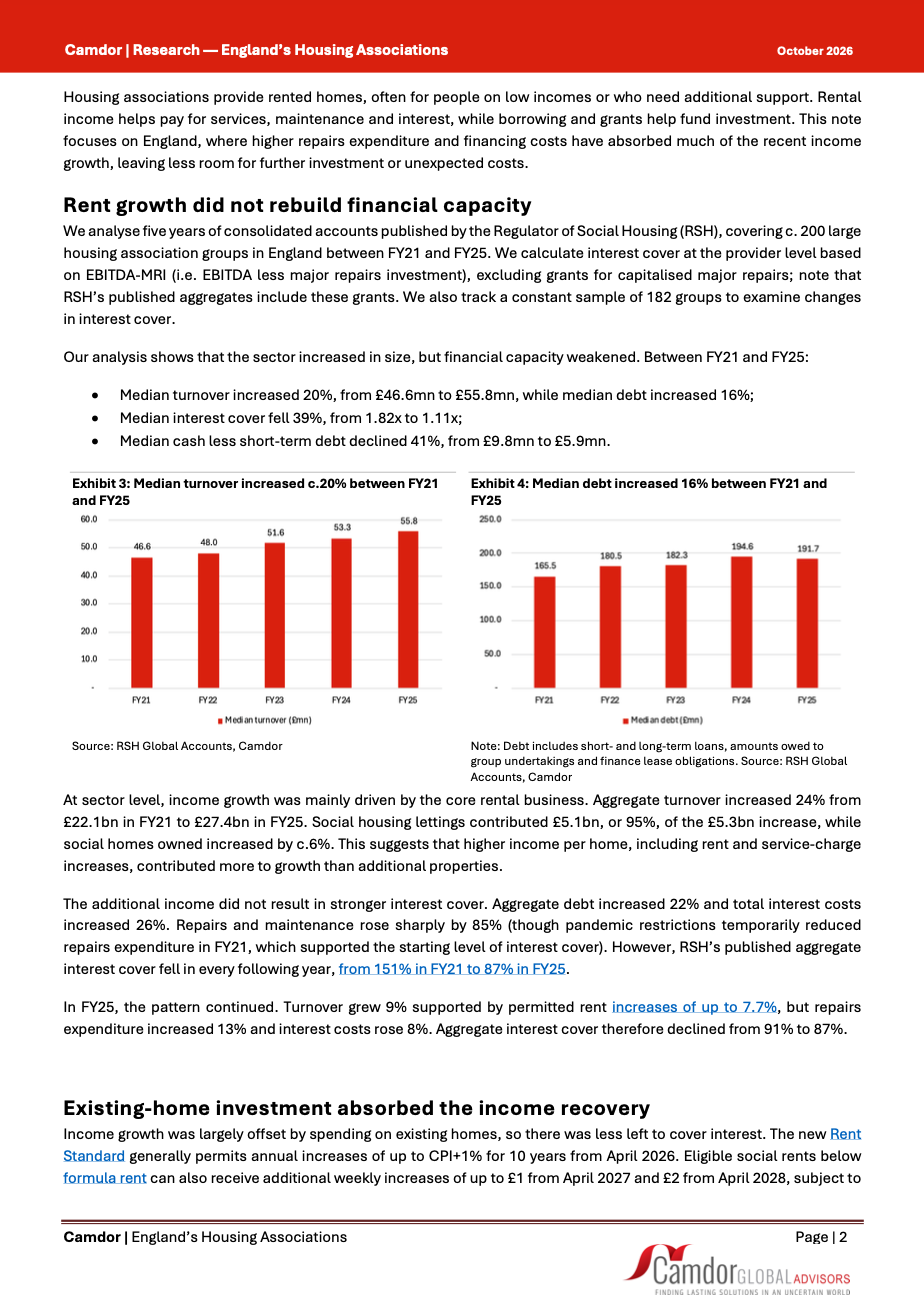
Higher repairs and financing costs have absorbed much of the income growth among England’s housing associations, leaving less room for investment or unexpected costs.
Our new research “Where Has the Financial Headroom Gone?” examines five years of sector accounts and what providers’ forecasts suggest about the scope for recovery.
Camdor Global Advisors can help housing associations assess financial headroom, stress-test business plans and compare funding and investment options.


Contact Camdor Global Advisors:
Bob Swarup
Swarup@camdorglobaladvisors.com
Emerson Chan
Emerson@camdorglobaladvisors.com
Douglas Sharp
Sharp@camdorglobaladvisors.com

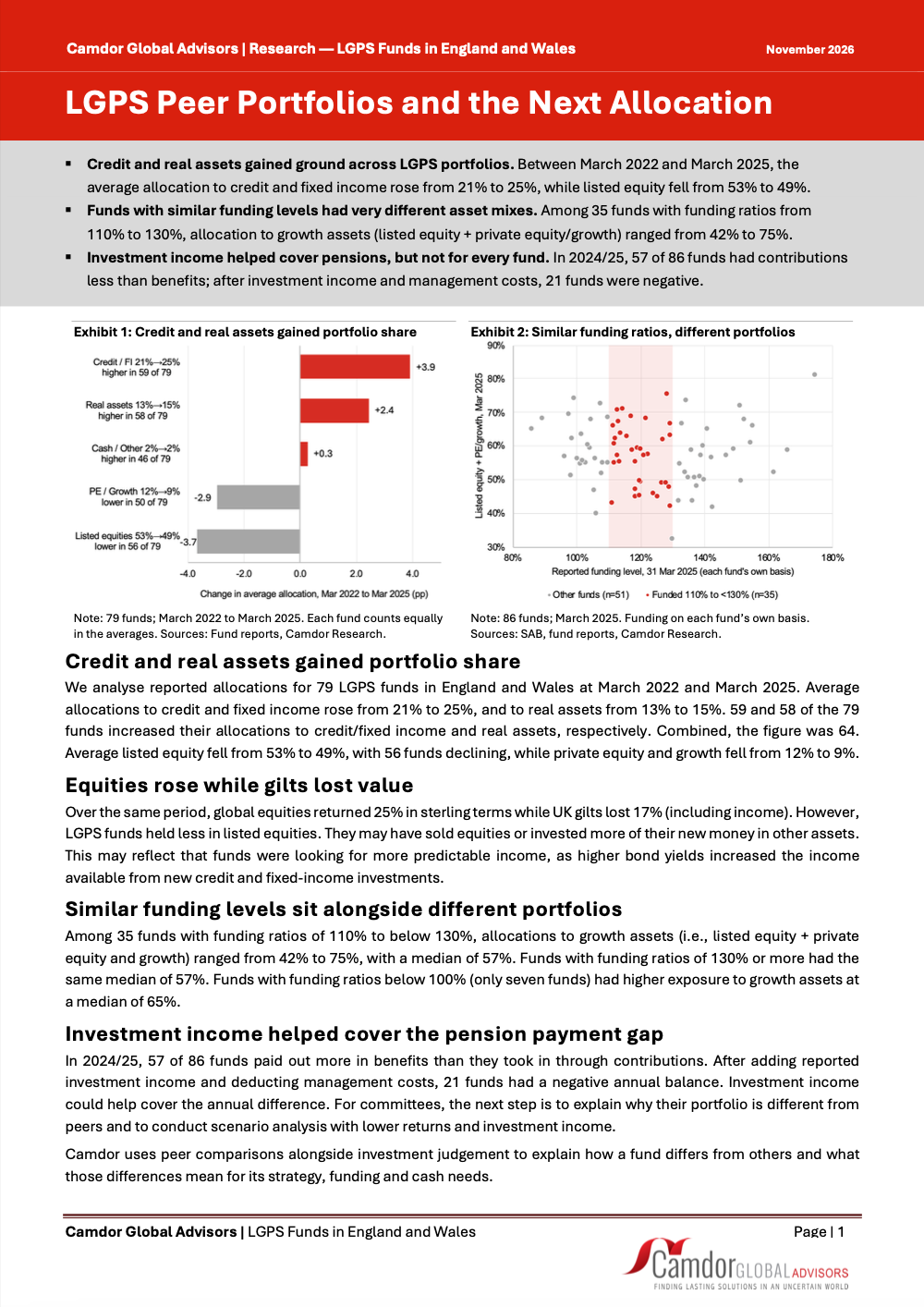
We analysed how LGPS funds changed their asset mix between March 2022 and March 2025:
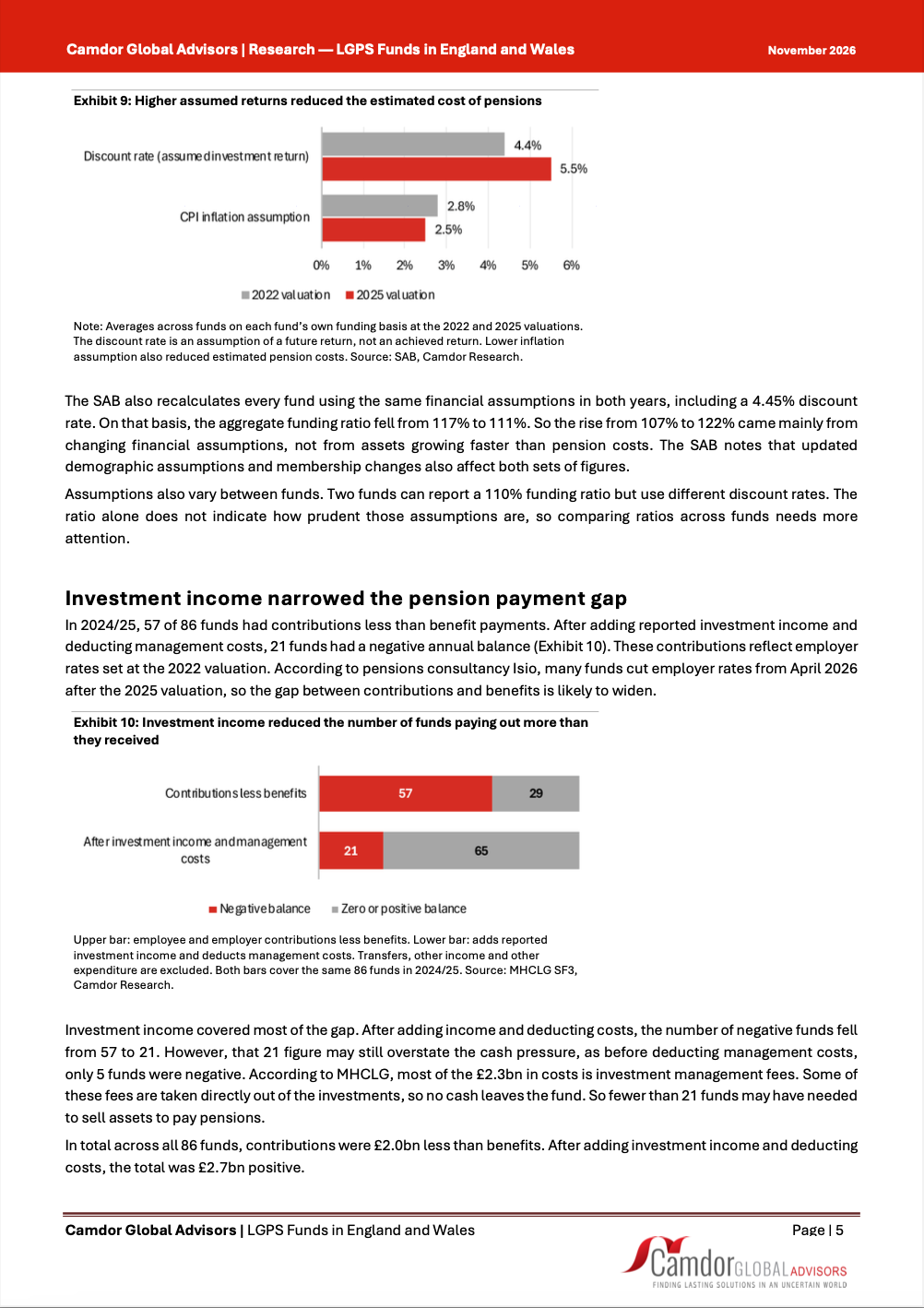
• Across 79 funds, credit and fixed income rose from 21% to 25% on average. Listed equity fell from 53% to 49%.
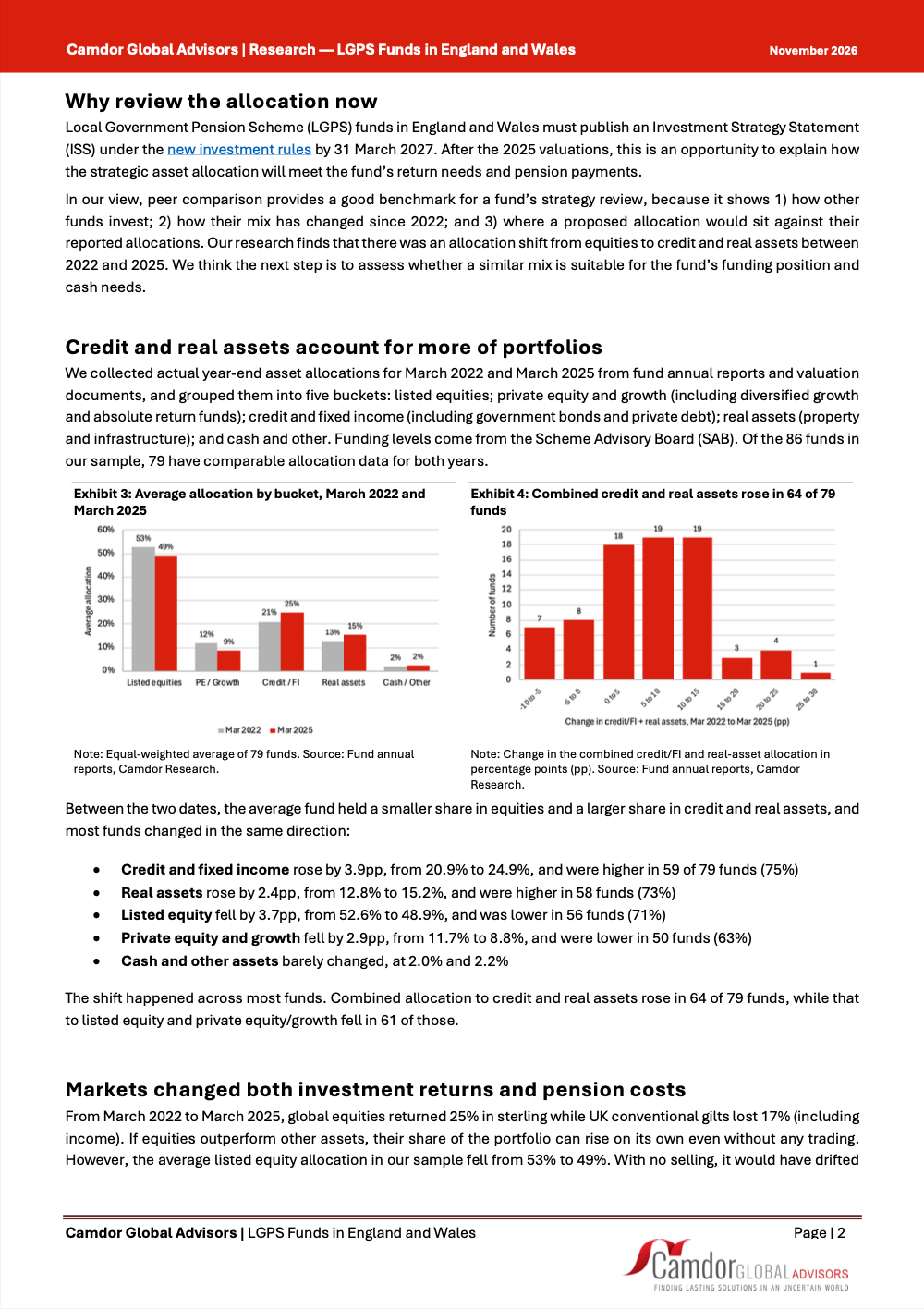
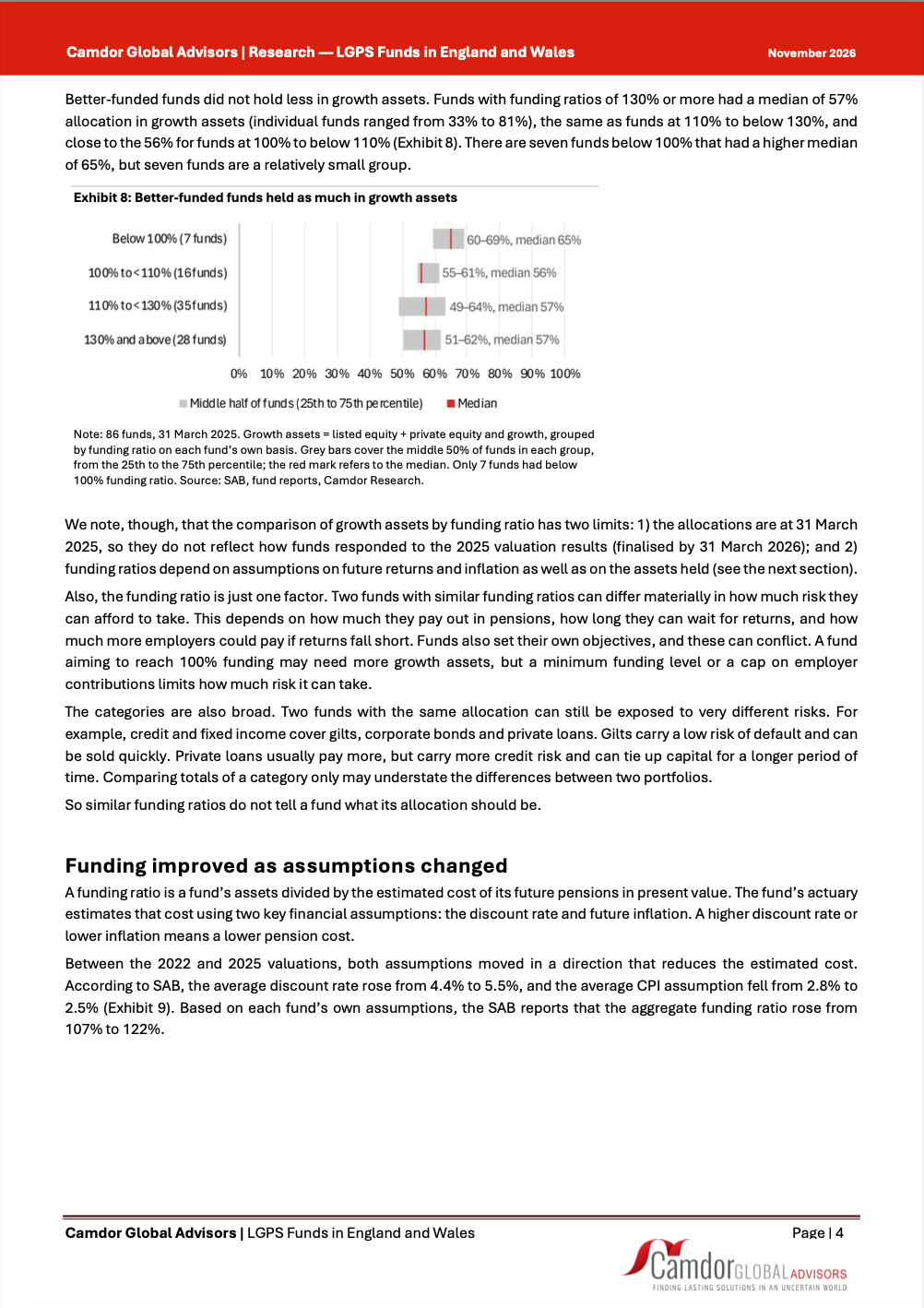
• Funds with similar funding levels hold very different asset mixes. Among 35 funds funded at 110% to 130%, growth assets ranged from 42% to 75%.
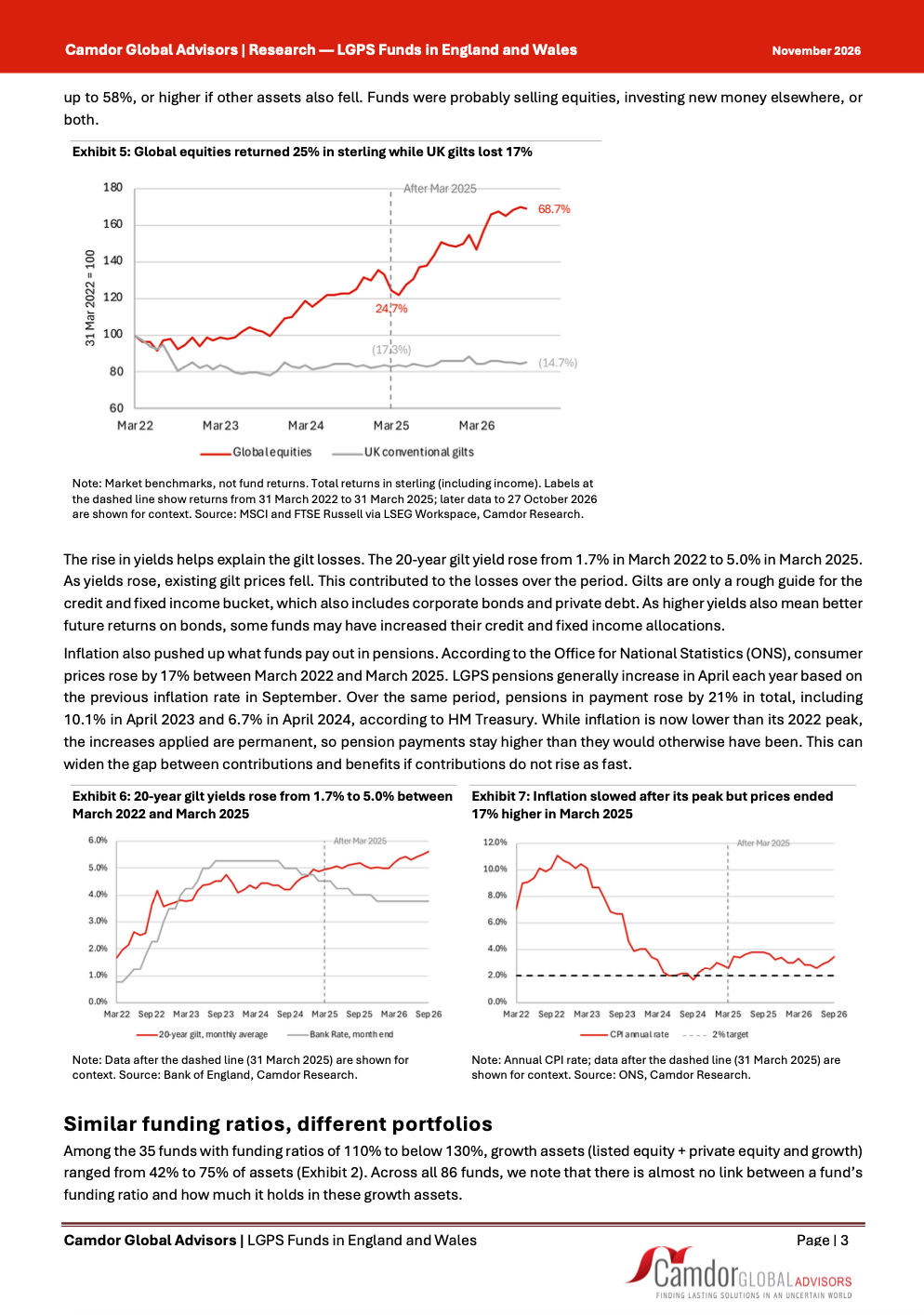
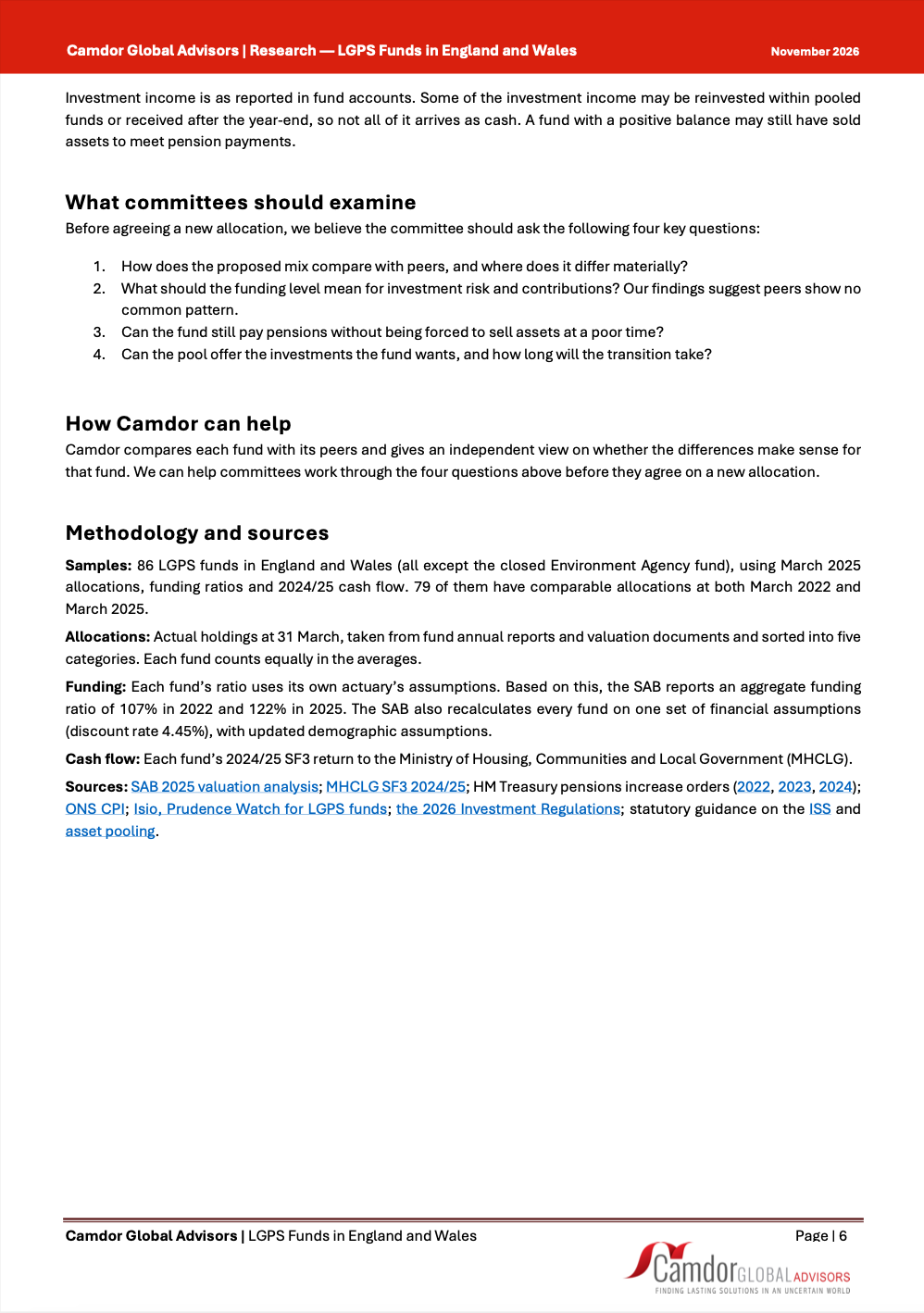
• In 2024/25, 57 of 86 funds paid out more in pensions than they received in contributions. After investment income and costs, 21 were still negative.
Seeing where your fund sits against peers is a good starting point for the new Investment Strategy Statement, due by March 2027.

Contact Camdor Global Advisors:
Bob Swarup
Swarup@camdorglobaladvisors.com
Emerson Chan
Emerson@camdorglobaladvisors.com
Douglas Sharp
Sharp@camdorglobaladvisors.com
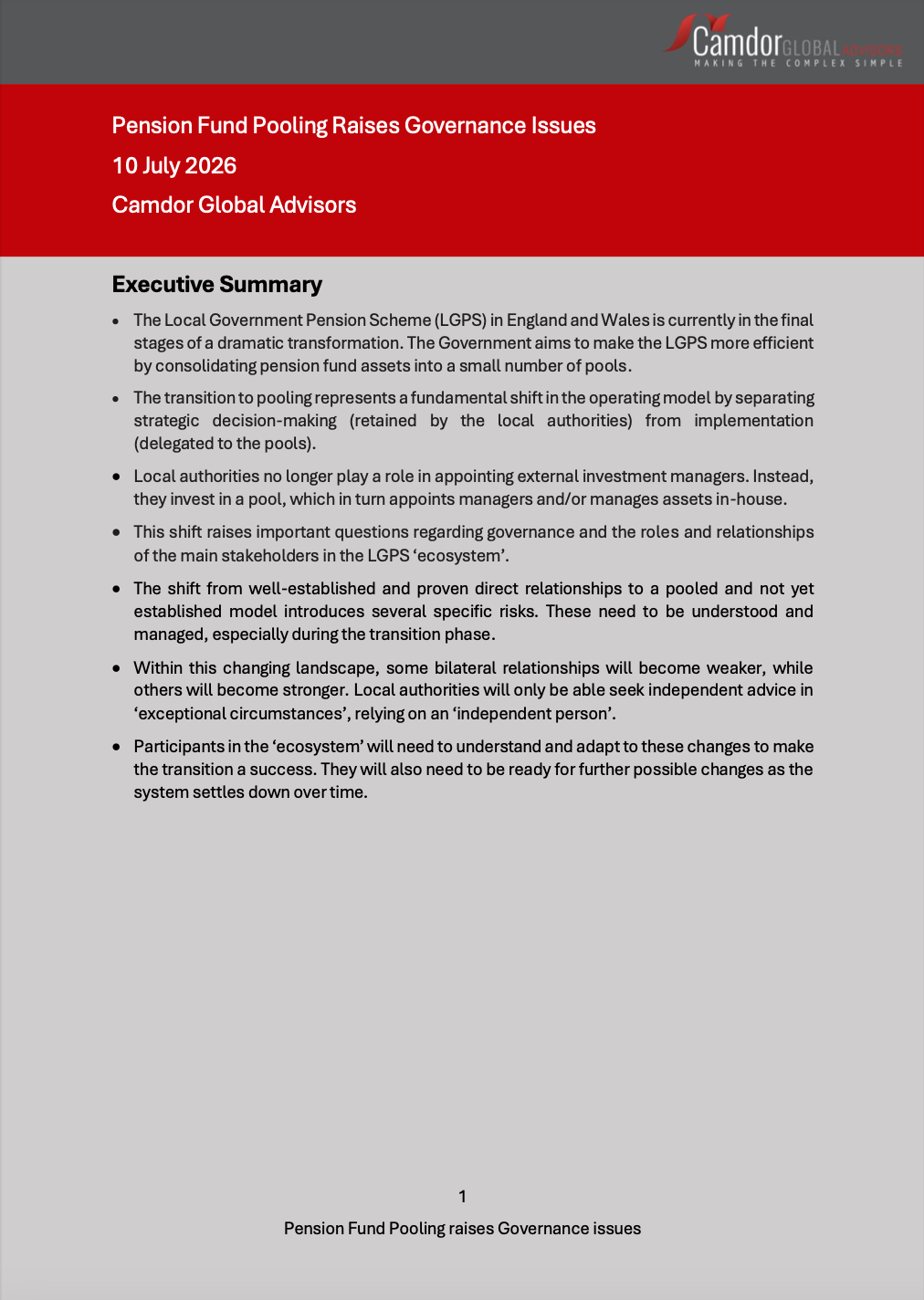
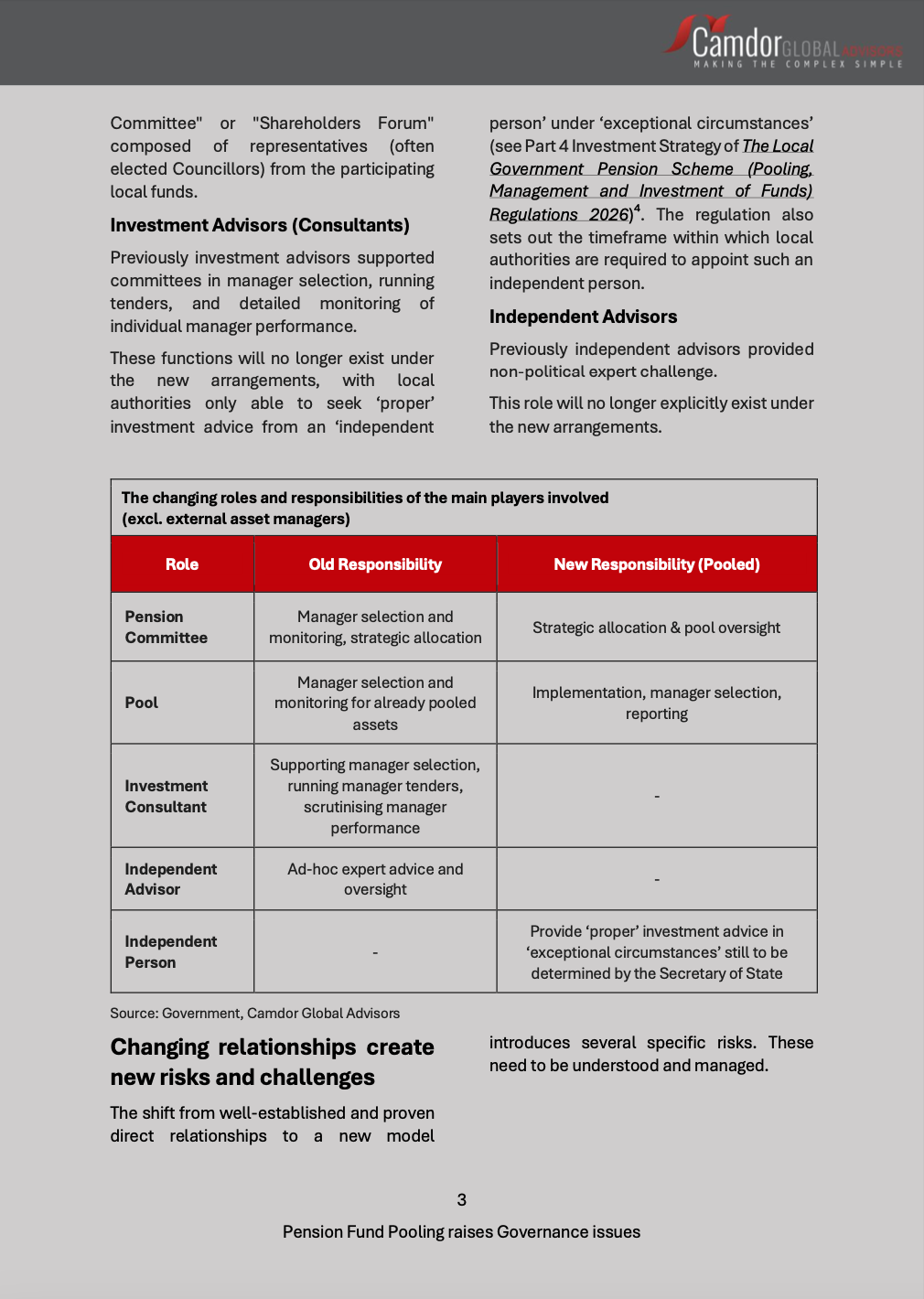
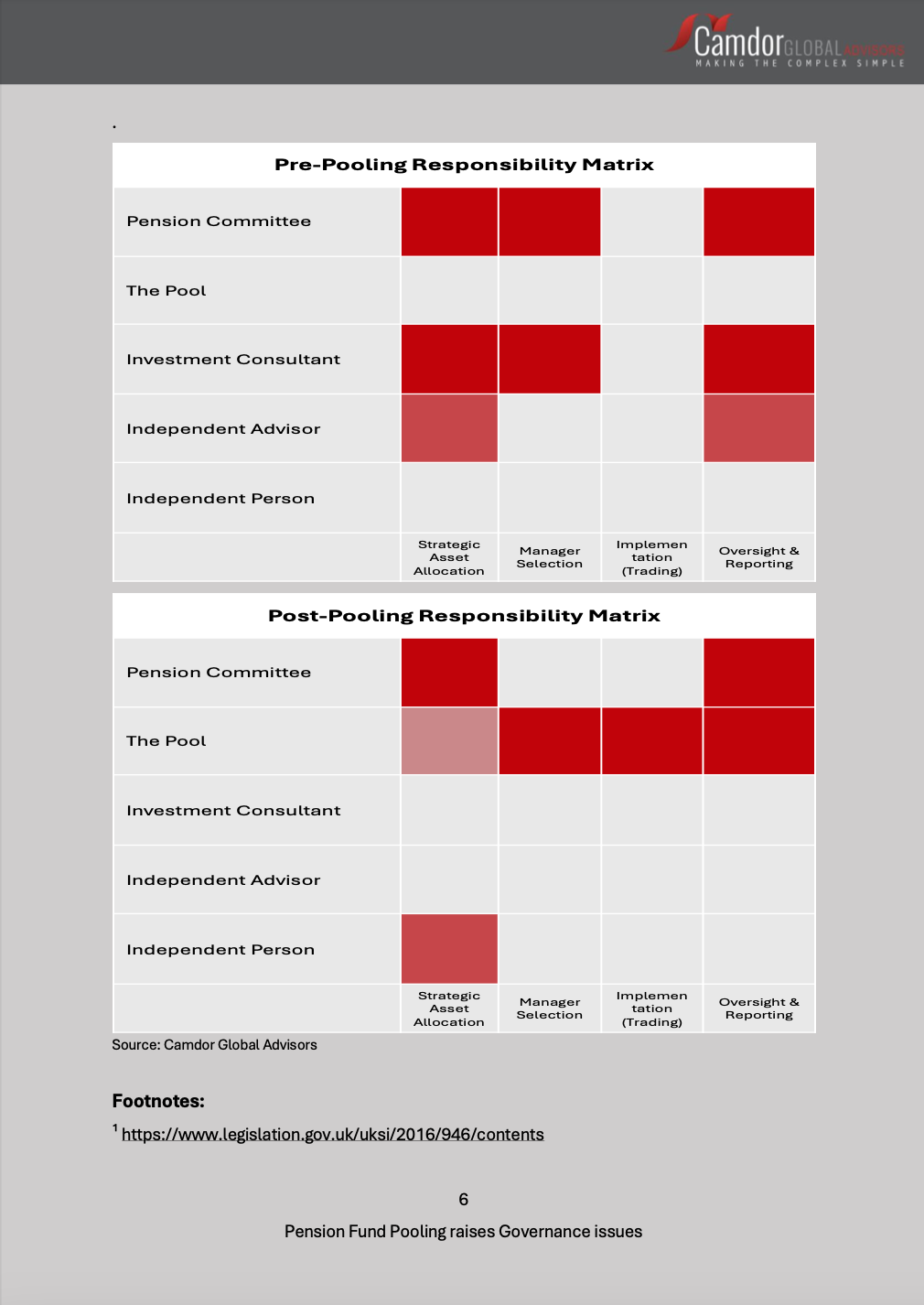
Local authority pension schemes are going through the largest transformation in a generation, with major responsibilities moving to pension pools.
This transformation provides opportunities but also carries risks. To make the transformation a lasting success, it is important to understand these risks and manage any potential governance issues that might arise.
Read our insight in which we set out the transformation taking place right now and assess the potential challenges that will need to be navigated.


Contact Camdor Global Advisors:
Bob Swarup
Swarup@camdorglobaladvisors.com
Dr Frank Eich
eich@camdorglobaladvisors.com
Douglas Sharp
Sharp@camdorglobaladvisors.com
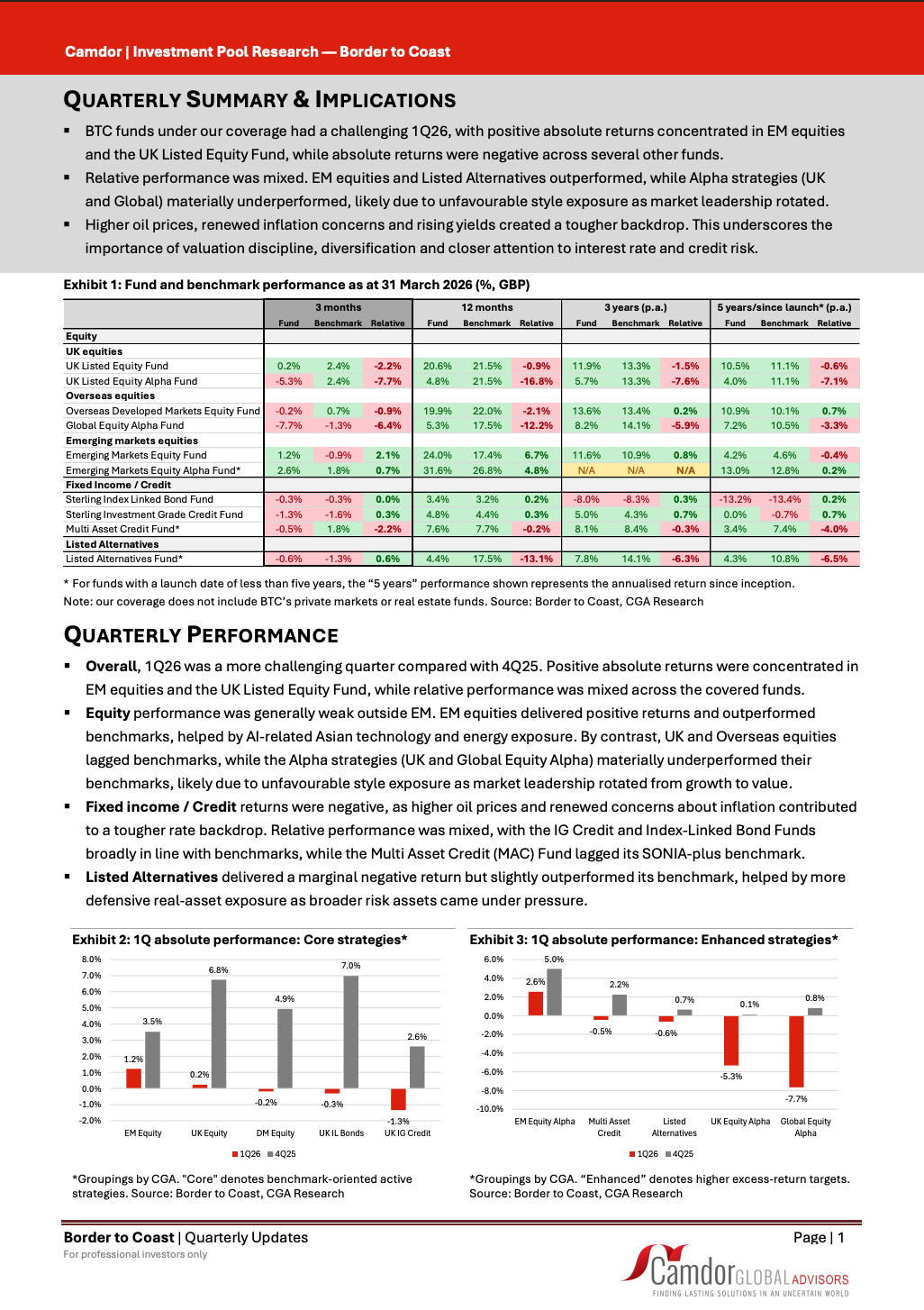
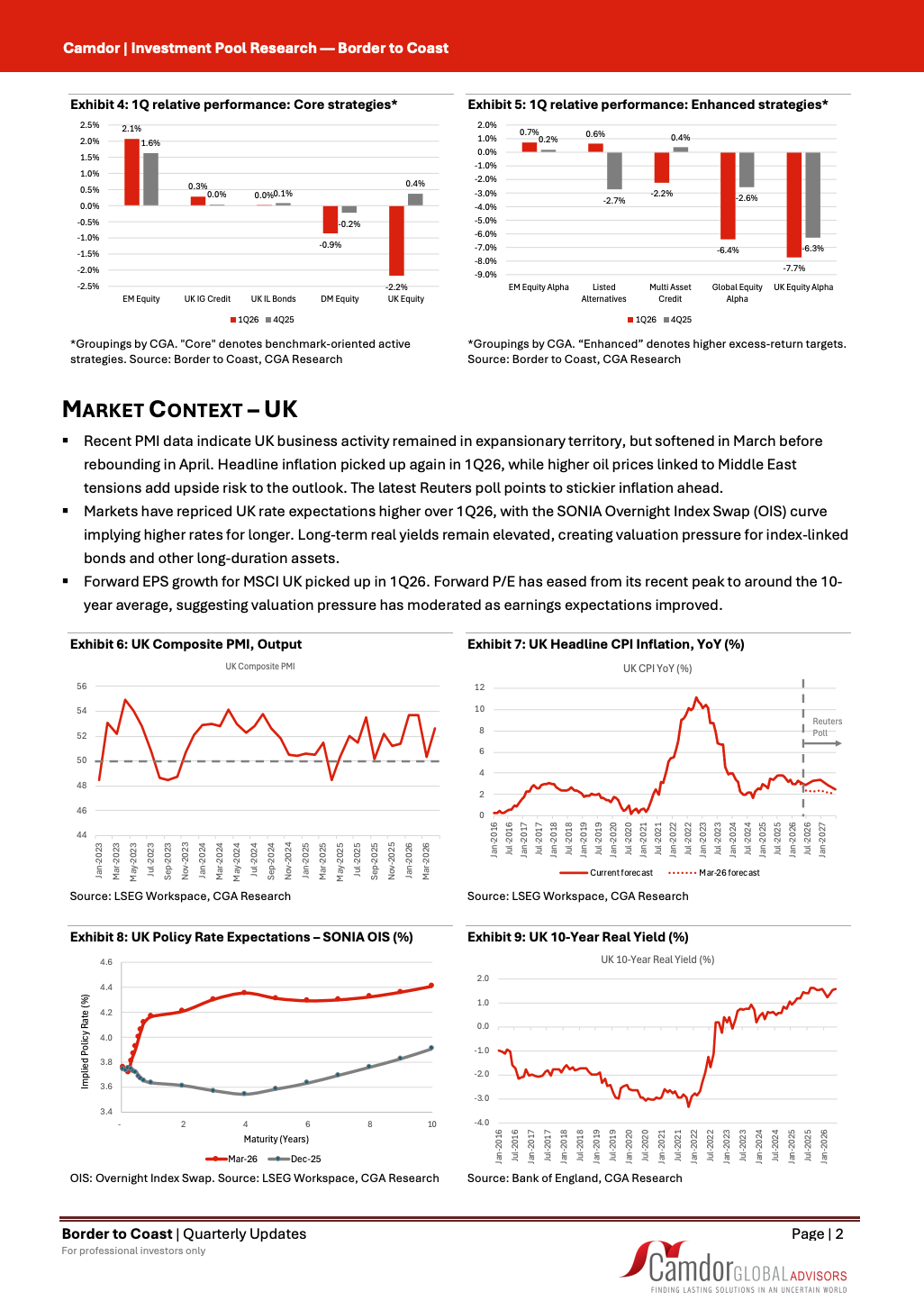
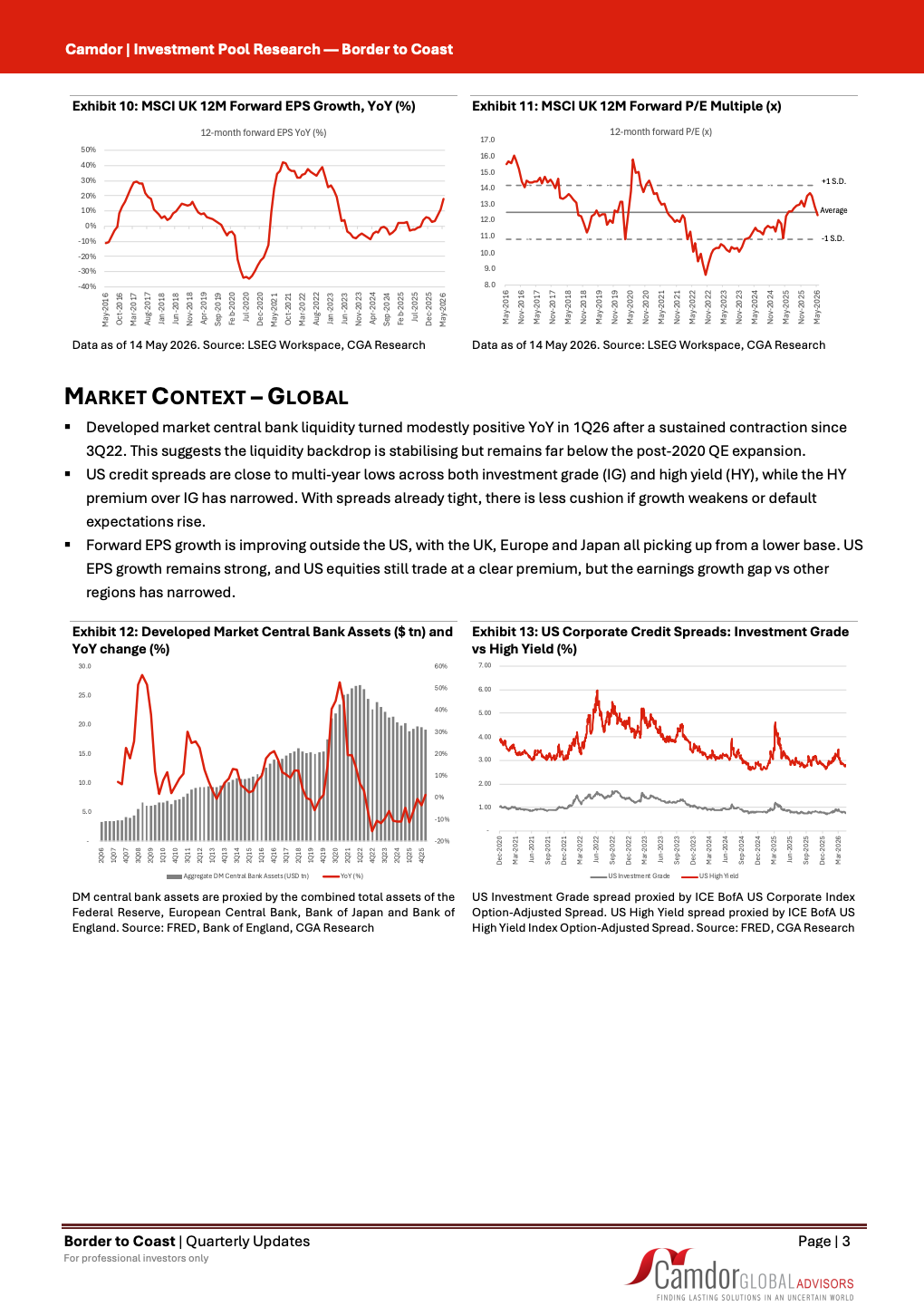
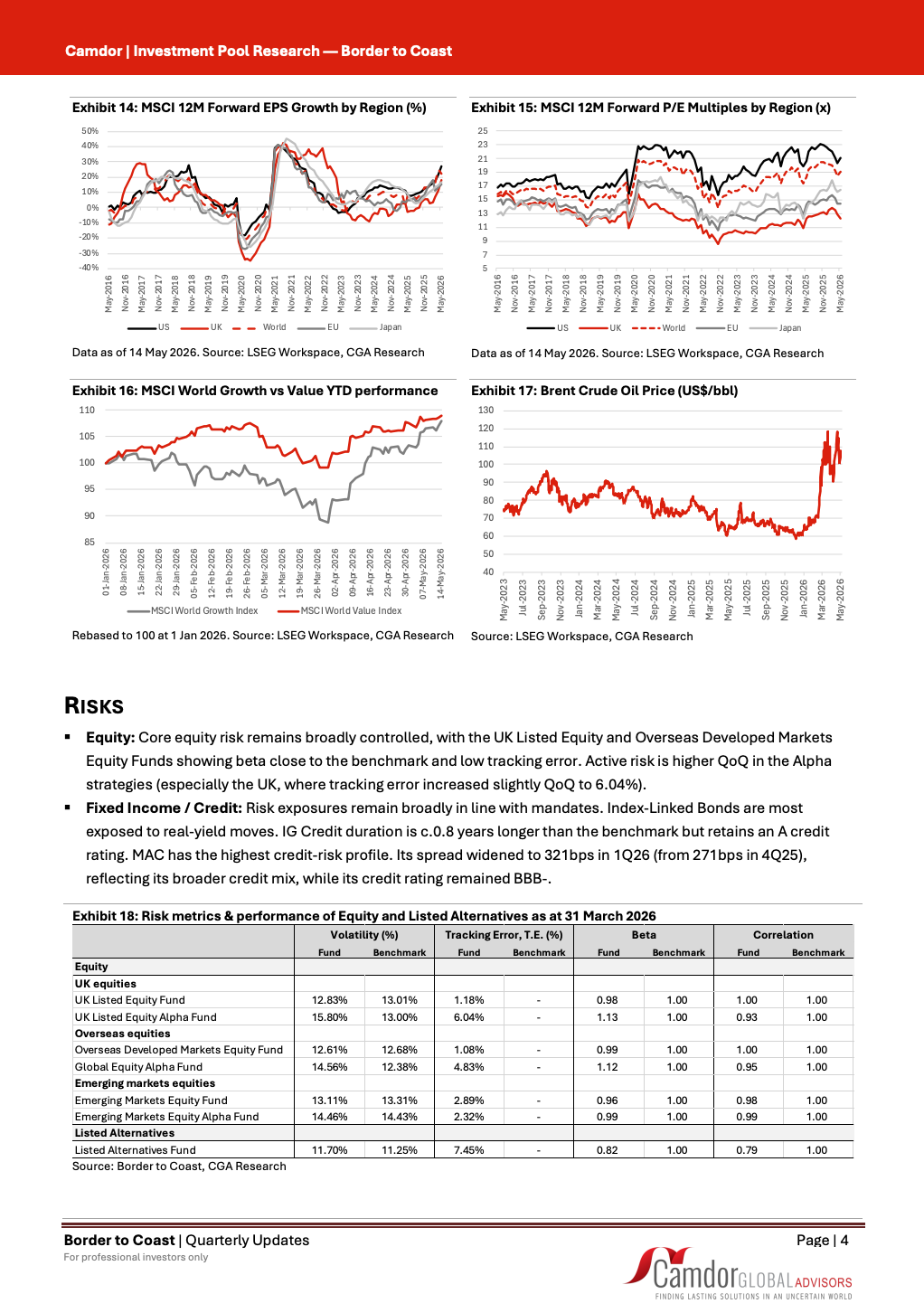
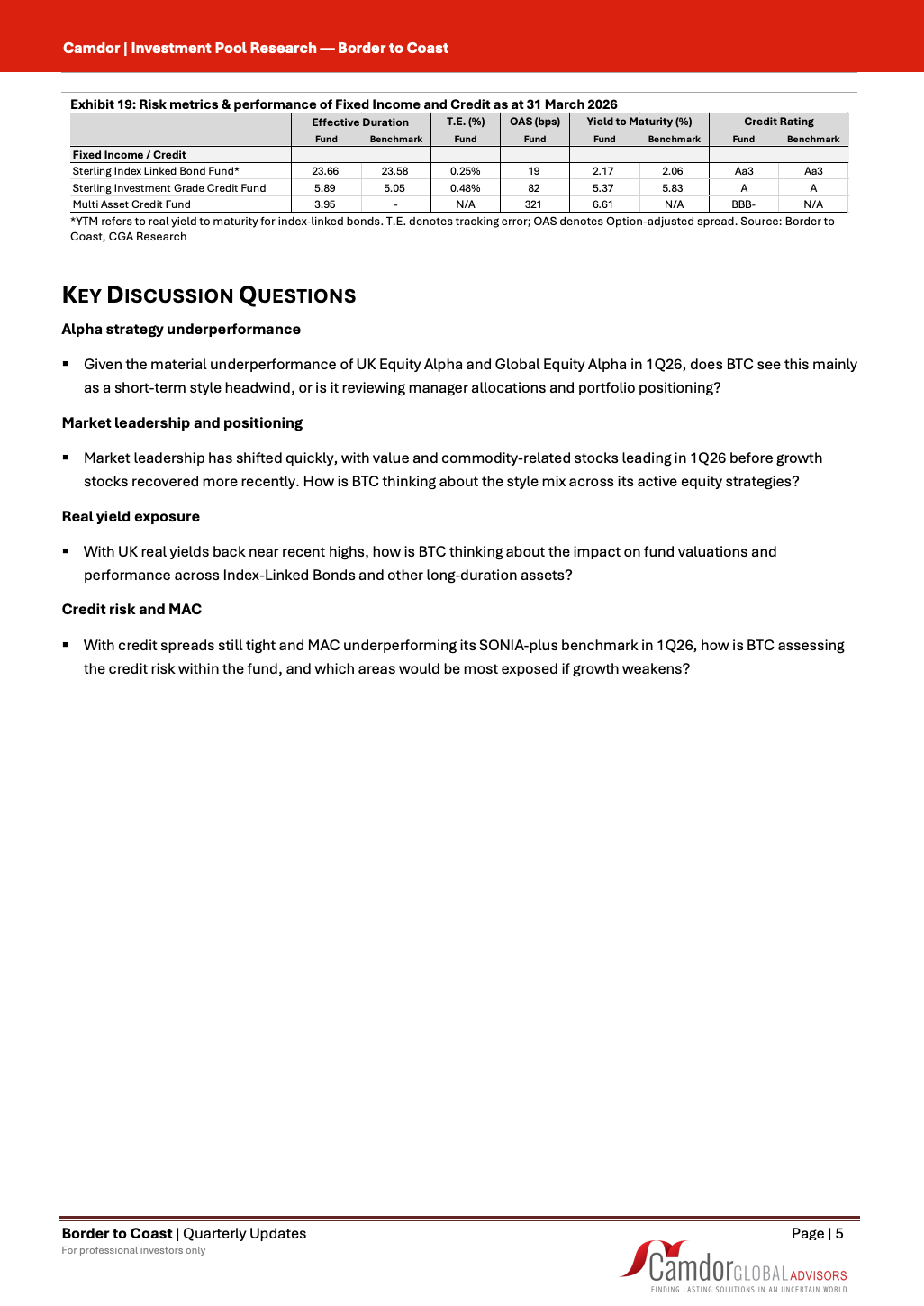
We are pleased to share our latest quarterly review of Border to Coast (BTC), covering 1Q26 fund performance, market backdrop, key risk considerations and discussion questions for LGPS fund oversight.
1Q26 was a challenging quarter, with positive absolute returns concentrated in EM equities and the UK Listed Equity Fund, while relative performance was mixed across the covered funds.
The report also discusses higher real yields, tight credit spreads and key questions around style exposure, diversification, interest-rate risk and credit risk.
For professional investors only.
Contact Camdor Global Advisors:
Emerson Chan
emerson@camdorglobaladvisors.com
Vittal Pathi
pathi@camdorglobaladvisors.com
On 21 July 2025, the UK Government made its first major announcement with the establishment of a new pensions commission that could reshape the country’s approach to retirement saving.
Amid the usual political noise from Westminster, this stands out for its potential to deliver lasting structural change and to redefine the state’s role in securing adequate incomes for future pensioners.
The new commission has been tasked with “finishing the job” started by its predecessor in the early 2000s. That earlier body recommended the introduction of workplace pensions with auto-enrolment, one of the most widely cited applications of behavioural economics in UK policymaking. This reform brought millions into pension saving, yet contribution rates remain too low to ensure adequate incomes in later life. The commission will now explore how to increase contributions and strengthen long-term sustainability.
It will also feed into a parallel review of the State Pension age, which will look at international models where pension age automatically adjusts in line with life expectancy. Bob Swarup and Frank Eich analysed similar proposals in 2009, in the wake of the first pensions commission, and their work may be worth revisiting.
The second announcement came with the publication of Sir Jon Cunliffe’s report on the future of the water sector in England and Wales. Sir Jon, a former Second Permanent Secretary to HM Treasury and Deputy Governor of the Bank of England, stresses that the supply of clean water is fundamental to the functioning of society. For this reason, it is often delivered by the public sector, as is the case in Scotland and Northern Ireland. In England and Wales, however, the sector was privatised in the 1980s, with the Government’s role confined to economic regulation via Ofwat.
Sir Jon concludes that this framework has failed to deliver and recommends a fundamental “reset” of the sector. Central to his proposals is the replacement of Ofwat with a new, more integrated regulator and supervisor. This new body would combine oversight of investment, daytoday operations, and longterm resilience.
These policy announcements come at a time when public finances are under sustained pressure. In this context, the Government is focused on two priorities. The first is to contain growth in state pension expenditure, since large increases in annual spending would add strain to the national budget. The second is to fix problems in struggling private utilities by improving regulation and management, thereby avoiding the high costs of taking them into public ownership.
However, the return of parts of the rail network to public ownership illustrates a gradual shift in the balance between public and private provision.
Whether the pensions commission and water sector reforms deliver meaningful change or remain at the level of consultation will hinge on political will and fiscal space.
For now, they are clear signals of where government priorities may be heading and will be closely watched by markets and policymakers alike.
On 21 July 2025, the UK Government made its first major announcement with the establishment of a new pensions commission that could reshape the country’s approach to retirement saving.
Amid the usual political noise from Westminster, this stands out for its potential to deliver lasting structural change and to redefine the state’s role in securing adequate incomes for future pensioners.
The new commission has been tasked with “finishing the job” started by its predecessor in the early 2000s. That earlier body recommended the introduction of workplace pensions with auto-enrolment, one of the most widely cited applications of behavioural economics in UK policymaking. This reform brought millions into pension saving, yet contribution rates remain too low to ensure adequate incomes in later life. The commission will now explore how to increase contributions and strengthen long-term sustainability.
It will also feed into a parallel review of the State Pension age, which will look at international models where pension age automatically adjusts in line with life expectancy. Bob Swarup and Frank Eich analysed similar proposals in 2009, in the wake of the first pensions commission, and their work may be worth revisiting.
The second announcement came with the publication of Sir Jon Cunliffe’s report on the future of the water sector in England and Wales. Sir Jon, a former Second Permanent Secretary to HM Treasury and Deputy Governor of the Bank of England, stresses that the supply of clean water is fundamental to the functioning of society. For this reason, it is often delivered by the public sector, as is the case in Scotland and Northern Ireland. In England and Wales, however, the sector was privatised in the 1980s, with the Government’s role confined to economic regulation via Ofwat.
Sir Jon concludes that this framework has failed to deliver and recommends a fundamental “reset” of the sector. Central to his proposals is the replacement of Ofwat with a new, more integrated regulator and supervisor. This new body would combine oversight of investment, daytoday operations, and longterm resilience.
this context, the Government is focused on two priorities. The first is to contain growth in state pension expenditure, since large increases in annual spending would add strain to the national budget. The second is to fix problems in struggling private utilities by improving regulation and management, thereby avoiding the high costs of taking them into public ownership.
These policy announcements come at a time when public finances are under sustained pressure. In this context, the Government is focused on two priorities. The first is to contain growth in state pension expenditure, since large increases in annual spending would add strain to the national budget. The second is to fix problems in struggling private utilities by improving regulation and management, thereby avoiding the high costs of taking them into public ownership.
However, the return of parts of the rail network to public ownership illustrates a gradual shift in the balance between public and private provision.
Whether the pensions commission and water sector reforms deliver meaningful change or remain at the level of consultation will hinge on political will and fiscal space.
For now, they are clear signals of where government priorities may be heading and will be closely watched by markets and policymakers alike.
The April pulse is here!
To view the latest pricing on investments and borrowings, please click here
Brief updates on the macro environment, markets and key ESG developments are below:
Global and UK Growth Outlook deteriorates due to Middle East Conflict
Cost of Living Support Measures Announced
UK Inflation Rises and BoE Rate Update Amid Conflict
Pension Schemes Bill Nears Completion Amid Parliamentary “Ping Pong” Stage
Devolution Reforms for England Continue to Progress
Clean Energy Transition Accelerates
We hope you find this update valuable.
If you have any questions for Camdor Global Advisors, please don’t hesitate to leave a comment down below, get in touch or check out our LinkedIn and website for more information.
We’re always happy to chat and assist where we can.
On 29 April the Pension Schemes Bill received Royal Assent and became law. It brings to a close a policy initiative which started in late 2024 with Chancellor Reeves’ first Mansion House speech.
According to the Government, this is a landmark bill, which will help more than 20 million people better save for their retirement and will boost UK growth. It aims to achieve that by reducing costs and boosting returns. It will also make it easier to consolidate smaller individual pension pots and allow the creation of multi-employer defined-contribution ‘megafunds’. Importantly, after much back and forth with the House of Lords, the Government agreed to tone down its original plans. These would have given it the power to mandate UK pension schemes to invest in private markets, half of this investment being in the UK.
It is good to see these proposed powers watered down. While we can see why the Government might want to steer pension investment to what it might consider to be “good causes”, it really should be for the schemes themselves to decide what is best for their members.
The Bill also put the finishing touches to the consolidation of the Local Government Pension Scheme into a few pools, which the government hopes will lead to economies of scale and generally better outcomes. This consolidation is nearly complete now, with pools already doing most of what they are expected to do. But as local authorities move from trusted and established arrangements involving appointed fund managers and independent advisors to new arrangements centred around powerful pools, they need to remain extra vigilant. Governance issues may emerge as the relationships between stakeholders change.